Overview
Dye testing was used as part of a detailed trace and access survey to locate a concealed drainage defect. Ongoing damp symptoms and unpleasant odours were present, but previous inspections had been unable to identify the source of the issue.
Challenges
The drainage system ran beneath floors and structural elements, limiting access and making invasive investigation undesirable. The challenge was to accurately locate the fault without unnecessary excavation or damage to the property.
Approach
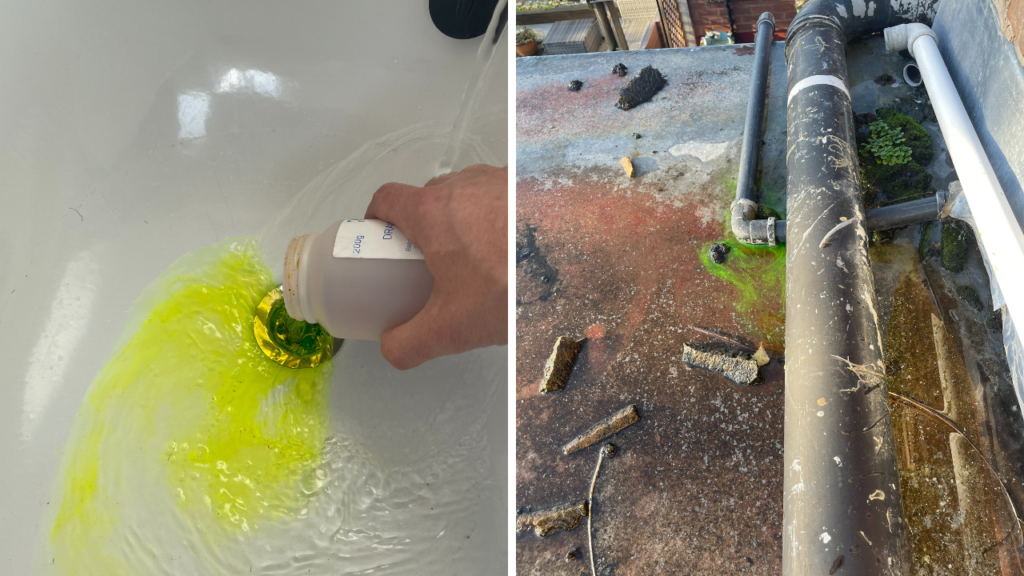
Our engineers carried out a full trace and access survey incorporating controlled drainage dye testing. A non toxic tracing dye was introduced into specific sections of the drainage system in sequence, with each run monitored through manholes and external inspection points.
By observing where the dyed water appeared outside the expected drainage route, irregularities within the system were identified with minimal disruption.
Solution
The dye testing clearly revealed a failure within a defined section of drainage pipework beneath the property. With the fault accurately located, a detailed trace and access report was provided, including photographic evidence and clear recommendations for repair.
This targeted diagnosis reduced repair costs, limited disruption, and supplied the documentation required for insurance purposes.
Related Services
Accurate drainage leak detection is often the first step in preventing further water damage and avoiding unnecessary disruption. Our trace and access surveys use proven diagnostic methods to support efficient repairs and insurance claims.